Bank of Canada hikes key interest rate to 0.5%
While the
bank has been telegraphing its plans to raise its rate to fight inflation for a
while now, the bank acknowledged in its announcement Wednesday that inflation
is heating up even faster than anticipated.
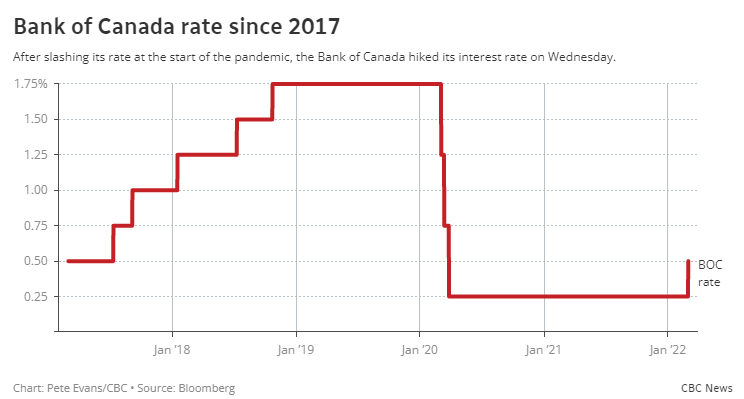
The Bank
of Canada raised its benchmark interest rate to 0.5 per cent on Wednesday, a
move that's expected to be the first of a series of small rate hikes this year
in an attempt to tame inflation that has risen to its highest point in decades.
It's the
first time the bank has raised its rate since 2018. Before the pandemic, the
bank's rate was 1.75 per cent, before it quickly slashed the rate down to 0.25
per cent to help the economy.
The Bank
of Canada's rate affects the rates that Canadian consumers get on things like
mortgages, lines of credit and savings accounts at their own banks.
The bank
cited news this week that Canada's economy grew at a 6.7 per cent annual pace in the last quarter of
2021, a figure that the bank described as "very strong."
"This
is stronger than the Bank's projection and confirms its view that economic
slack has been absorbed."
The bank
also cited factors beyond Canada's borders as reasons for its move.
"Economies
are emerging from the impact of the Omicron variant of [coronavirus] more
quickly than expected," the bank said.
Investors
think there could be as many as five more small rate hikes before the year 2022
is out. Adam Brown with BDO Canada told CBC News in an interview that there's
"no need to panic" but Wednesday's move clearly shows that rates are
finally going to start inching higher.
War
in Ukraine a factor
The Bank
of Canada cited the ongoing invasion of Ukraine as yet another factor that
could influence inflation, or other parts of Canada's economy.
Among
other things, Russia's unprovoked attack on its neighbour has caused the price
of commodities like fertilizer, natural gas and oil to skyrocket, as the
country is a major producer of these items.
Canada is
one of many countries that have pledged to no longer import oil from Russia,
but one of the impacts of that move is to cause the price to spike. The price
of the North American crude oil benchmark known as West Texas Intermediate topped
$111 a barrel on Wednesday, its highest price in eight years.
That
drives up the price for energy that all Canadian consumers and businesses
need, which will further contribute to inflation.
"The
invasion of Ukraine is putting further upward pressure on prices for both
energy and food-related commodities," the bank said. "All told,
inflation is now expected to be higher in the near term than projected in
January."
To read
more click on the link below…
https://www.bankofcanada.ca/2022/03/fad-press-release-2022-03-02/
